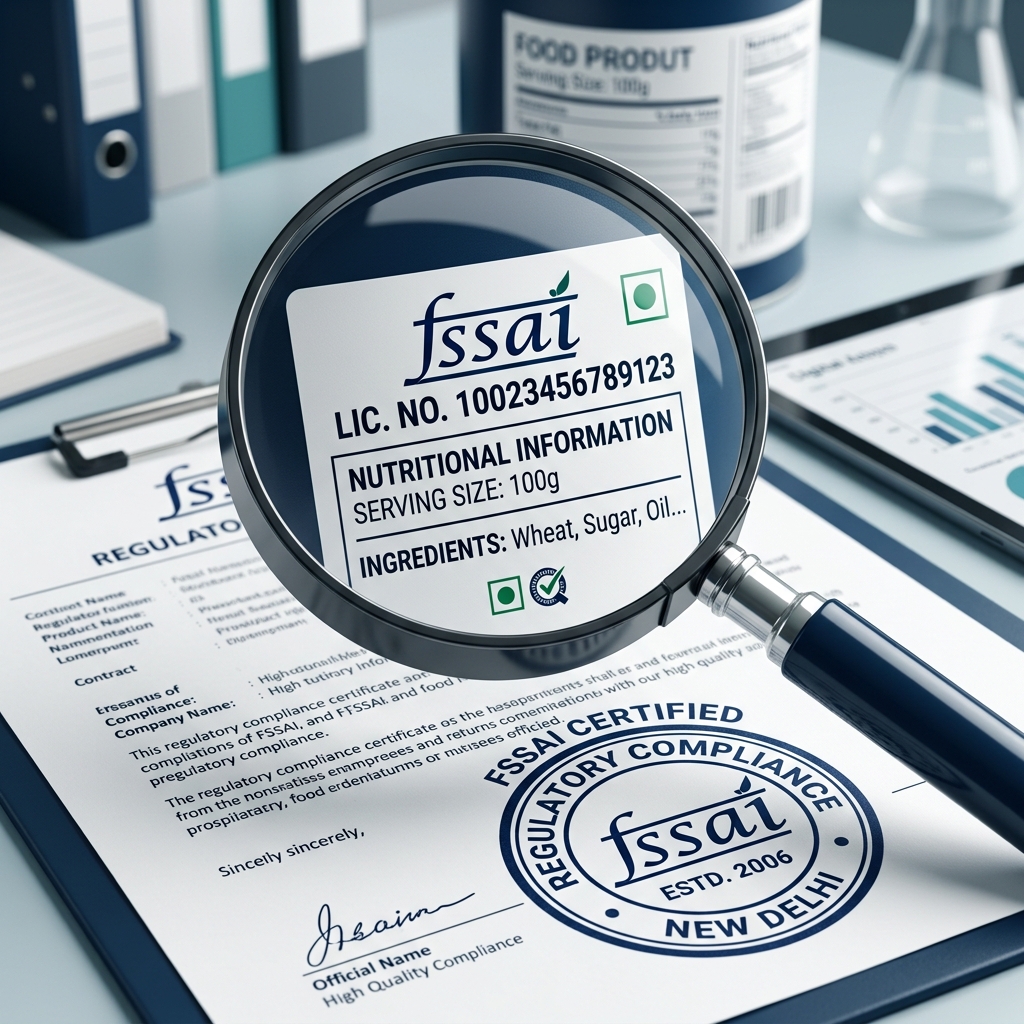
Packaging and labeling are the first points of interaction between your product and the consumer—and the FSSAI inspector in Panchkula. Under the FSS (Labelling and Display) Regulations, failure to comply leads to heavy penalties.
Mandatory Declarations Checklist
Every food label in India must contain these core declarations, displayed prominently and in English or Hindi (other languages optional).
- Name of Food: Prominent and reflective of the product nature.
- Ingredient List: In descending order of weight or volume.
- Nutritional Info: Per 100g/100ml and per serve (including RDS).
- Veg/Non-Veg Logo: Specific dimensions based on the pack size.
- FSSAI Logo & License: High contrast with the background.
- Net Quantity: With appropriate unit symbols.
- Expiry/Use-By: Clear DD/MM/YY format.
Ingredient List Rules
Compound ingredients (ingredients made of multiple items) must disclose their sub-components in brackets. For example: Chocolate [Sugar, Cocoa Butter, Milk Solids].
Nutritional Display Standards
The table must include Energy, Protein, Carbohydrates (Total & Added Sugars), Total Fat, Saturated Fat, Trans Fat, and Sodium. Claims like "Zero Trans Fat" require specific laboratory substantiation.
FSSAI Logo Dimensions
The FSSAI logo and license number must be in close proximity. The minimum height of the numerals must be 1mm for packs under 100cm² and increase proportionally for larger packs.
Veg/Non-Veg Symbols
The green/brown symbol is the most recognized mark on Indian labels. The size of the dot and the surrounding square is strictly defined by the area of the Principal Display Panel.
Date Formats & Storage
The "Date of Manufacture" and "Best Before" date must be clear. Storage instructions like "Store in a cool, dry place" are mandatory if the product's stability depends on it.
Is your Panchkula label 2026-ready? Our regulatory team provides a 100% Compliance Certificate after a professional audit.
Request Label Audit